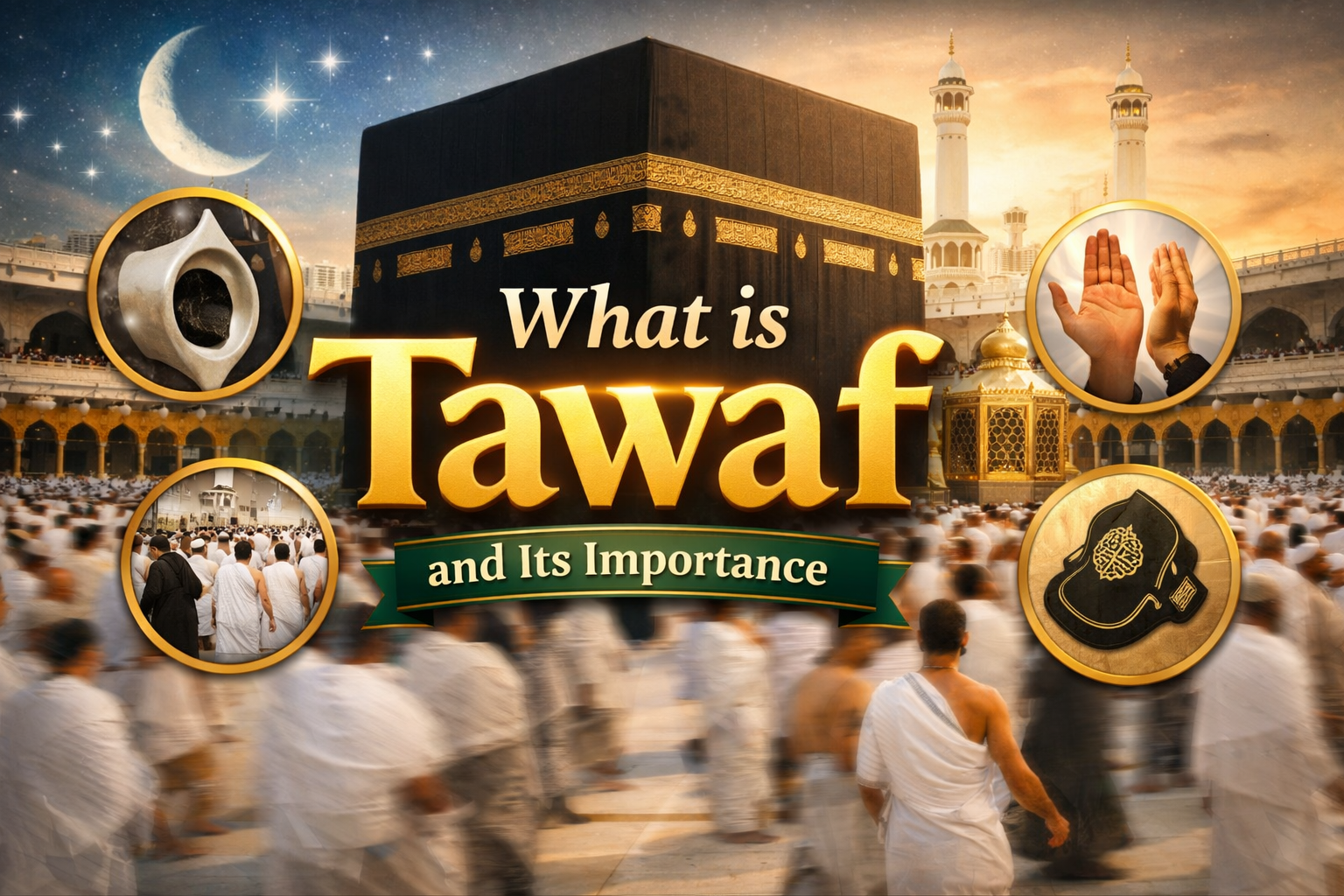
What is Tawaf and Its Importance
Tawaf (طواف) is one of the most essential and spiritually significant rituals in Islam, performed during both Hajj and Umrah. It involves circling the sacred Kaaba seven times in an anti-clockwise direction, starting from the Black Stone. This act of worship symbolizes unity, devotion, and submission to Allah.
Meaning of Tawaf
The Arabic root “tawaf,” which means “to circle around something,” is where the word Tawaf comes from. Tawaf is a ritual that Muslims do around the Kaaba, which is the holiest place in Islam and is in Mecca.
It is not just a physical act; it is a deeply spiritual experience that brings a believer closer to Allah.
Types of Tawaf
There are several types of Tawaf, each with its own purpose:
1. Tawaf al-Qudum (Arrival Tawaf)
Tawaf al-Qudum is the first Tawaf performed by pilgrims when they arrive in the holy city of Mecca for Hajj. It is considered a welcome Tawaf, symbolizing the pilgrim’s arrival into the sacred state of worship.
- It is Sunnah (recommended) for those performing Hajj al-Ifrad or Hajj al-Qiran.
- Pilgrims perform it before starting other Hajj rituals.
- Men often perform Idtiba (keeping the right shoulder uncovered) and Ramal (walking briskly in the first three rounds).
- It sets the spiritual tone for the entire pilgrimage, helping believers mentally and spiritually prepare for the days ahead.
This Tawaf reflects excitement, humility, and gratitude as the pilgrim enters the sacred sanctuary and sees the Kaaba for the first time.
2. Tawaf al-Ifadah (Main Tawaf of Hajj)
Tawaf al-Ifadah is the most important and compulsory Tawaf of Hajj. Without performing it, Hajj is incomplete.
- It is performed after returning from Mina and completing major rituals like stoning (Rami) and sacrifice.
- It usually takes place on the 10th of Dhul-Hijjah or later.
- This Tawaf is also known as Tawaf az-Ziyarah.
- Pilgrims must be in a state of purity (Wudu), and proper conditions of Tawaf must be fulfilled.
In a spiritual sense, this Tawaf is a way to reconnect with Allah after doing the most intense rituals of Hajj. It means being clean and accepting one’s pilgrimage.
3. Tawaf al-Wida (Farewell Tawaf)
Tawaf al-Wida is the final Tawaf performed before leaving Mecca.
- It is obligatory (Wajib) for all pilgrims except women in menstruation.
- It must be the last ritual before departing from Mecca.
- No other major activity should be done after this Tawaf.
This Tawaf means a lot to me on an emotional level. As they get ready to leave the holy city, pilgrims often feel sad and thankful. It is a way to say goodbye to the Kaaba and hope to come back someday.
4. Tawaf al-Umrah
Tawaf al-Umrah is an essential pillar (Fard) of Umrah.
- It is performed immediately after entering the state of Ihram and arriving in Mecca.
- Without this Tawaf, Umrah is not valid.
- After completing Tawaf, pilgrims perform Sa’i between Safa and Marwah.
This Tawaf is the start of the Umrah journey and shows that you are completely devoted to Allah. People often do it with a lot of concentration because Umrah is shorter but very rewarding.
5. Tawaf al-Nafl (Voluntary Tawaf)
Tawaf al-Nafl is a voluntary act of worship that can be performed anytime when a person is in Mecca.
- It is not linked to Hajj or Umrah specifically.
- Pilgrims and residents can perform it whenever they wish to gain extra reward.
- There is no limit to how many times it can be performed.
This Tawaf shows how beautiful Islam is by letting believers get closer to Allah in ways other than the ones that are required. One of the most spiritually rewarding things you can do is to do Nafl Tawaf around the Kaaba.
How is Tawaf Performed?

Tawaf is performed in a specific manner:
- Make the intention (niyyah) for Tawaf.
- Begin at the Black Stone (Hajar al-Aswad).
- Complete seven circuits around the Kaaba.
- Move in an anti-clockwise direction.
- Recite supplications (duas) and remember Allah during each round.
- After completing Tawaf, perform two Rakats of prayer near Maqam Ibrahim.
Spiritual Importance of Tawaf
1. Symbol of Unity
Millions of Muslims from around the world gather and perform Tawaf together, showing the unity of the Ummah regardless of race, language, or nationality.
2. Expression of Devotion
Tawaf represents complete submission to Allah, as believers revolve around His sacred house just like planets orbit in the universe.
3. Purification of the Soul
Performing Tawaf with sincerity helps cleanse sins and strengthens faith.
4. Following the Sunnah
Tawaf follows the practice of Prophet Muhammad, making it a highly rewarding act.
Benefits of Tawaf
- Brings inner peace and spiritual satisfaction
- Strengthens connection with Allah
- Encourages patience and discipline
- Reminds Muslims of the Day of Judgment and unity before Allah
Common Mistakes During Tawaf
- Pushing or harming others in the crowd
- Forgetting the intention (niyyah)
- Treating Tawaf as a ritual without understanding its meaning
- Ignoring proper etiquette and respect for the holy place
Conclusion
Tawaf is not just walking around the Kaaba; it is a deep act of worship that shows love, obedience, and humility before Allah. It has a lot of spiritual value and reminds all Muslims of their unity and purpose, whether they do it during Hajj or Umrah.
FAQ (Frequently Asked Questions)
1. How many times should Tawaf be performed?
Tawaf consists of seven rounds around the Kaaba.
2. Can Tawaf be performed without Wudu?
No, being in a state of purity (Wudu) is required for Tawaf.
3. Is Tawaf compulsory in Umrah?
Yes, Tawaf is a mandatory pillar of Umrah.
Also Read This : Ihram Rules for Men And Women