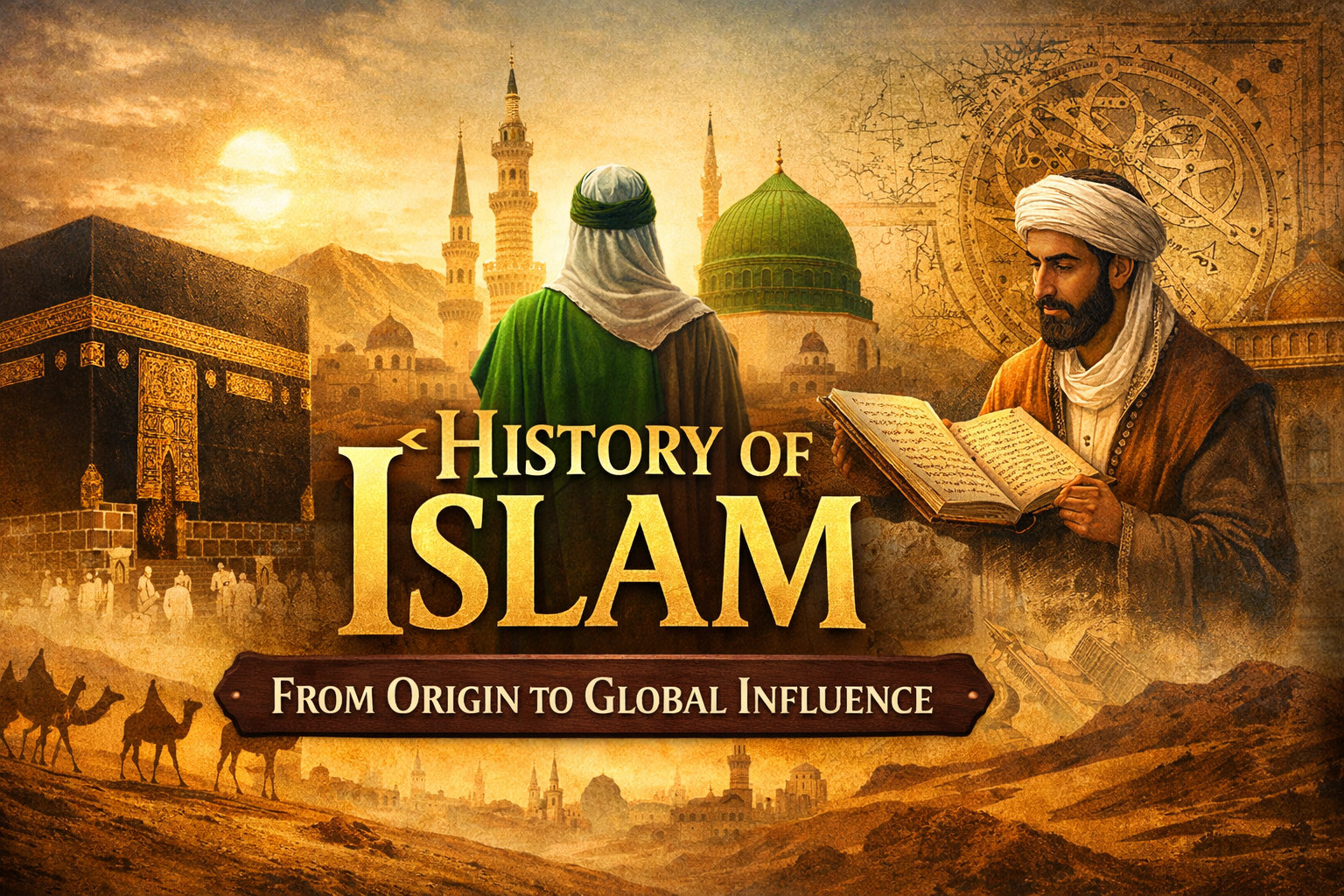
What is Islam (اسلام)?
Islam is one of the world’s major religions, followed by more than a billion people across the globe. Its history spans over 1400 years and is deeply rooted in spiritual teachings, social reforms, and cultural development. Understanding the history of Islam helps us appreciate its impact on civilization, knowledge, and global unity.
Islamic History Explained: Islam is a monotheistic religion that teaches belief in one God (Allah) and follows the message of Prophet Muhammad (peace be upon him). The holy book of Islam is the Quran, which Muslims believe is the final revelation from Allah.
The word “Islam” means submission to the will of Allah, and a follower of Islam is called a Muslim.
Pre-Islamic Arabia (Before Islam)
Before Islam began, the Arabian Peninsula was known for tribal divisions, idol worship, and social injustice. This period is often referred to as the “Age of Ignorance” (Jahiliyyah).
Key features of pre-Islamic Arabia:
- Worship of multiple idols
- Tribal conflicts and wars
- Lack of social equality
- Poor treatment of women and weaker sections
Makkah was already an important trade and religious center because of the Kaaba, but its original monotheistic purpose had been lost.
Birth of Prophet Muhammad (PBUH)
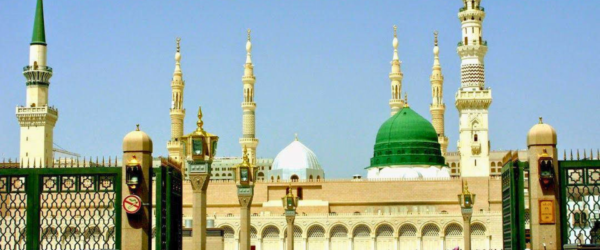
Prophet Muhammad (PBUH) was born in 570 CE in Makkah. He belonged to the respected Quraysh tribe. Known for his honesty and good character, he was called “Al-Amin” (the trustworthy).
At the age of 40, he received the first revelation from Allah through the Angel Jibreel (Gabriel) in the Cave of Hira. This marked the beginning of Islam.
Early Spread of Islam
In the early years, Prophet Muhammad (PBUH) secretly preached the message of Islam, calling people to worship one God and abandon idol worship.
However, as Islam began to spread, the leaders of Makkah opposed him strongly. Muslims faced persecution, torture, and social boycott.
Despite these challenges, the number of believers slowly increased.
Migration to Madinah (Hijrah)
In 622 CE, Prophet Muhammad (PBUH) and his followers migrated from Makkah to Madinah. This event is known as the Hijrah and marks the beginning of the Islamic calendar.
In Madinah:
- The first Muslim community was established
- A constitution was created for peaceful coexistence
- Islam began to grow rapidly
Establishment of Islamic Society
In Madinah, Islam was not only a religion but also a complete way of life. Prophet Muhammad (PBUH) established a society based on:
- Justice
- Equality
- Brotherhood
- Religious tolerance
He resolved conflicts, built alliances, and strengthened the Muslim community.
Conquest of Makkah
In 630 CE, Prophet Muhammad (PBUH) returned to Makkah with a large group of followers. The city was conquered peacefully.
One of the most important actions during this event was the removal of idols from the Kaaba, restoring it as a place of worship for one God.
This marked a major turning point in the history of Islam.
Farewell Pilgrimage and Final Message
In 632 CE, Prophet Muhammad (PBUH) performed his final Hajj, known as the Farewell Pilgrimage.
During this time, he delivered a powerful sermon emphasizing:
- Equality of all humans
- Rights of women
- Justice and fairness
- Unity among Muslims
Soon after, he passed away, leaving behind a complete message of Islam.
Expansion of Islam After the Prophet
After the death of Prophet Muhammad (PBUH), Islam continued to spread rapidly under the leadership of the Caliphs.
1. Rashidun Caliphate (632–661 CE)
The first four Caliphs expanded Islamic rule and preserved the teachings of Islam.
2. Umayyad Caliphate (661–750 CE)
Islam spread across North Africa, Spain, and parts of Asia.
3. Abbasid Caliphate (750–1258 CE)
This period is known as the Golden Age of Islam, marked by advancements in science, medicine, mathematics, and education.
Golden Age of Islam

During the Abbasid period, the Muslim world became a center of knowledge and innovation.
Major contributions include:
- Development of algebra and mathematics
- Advances in medicine and surgery
- Preservation of ancient Greek and Roman knowledge
- Growth of libraries and universities
Islam in the Modern World
Today, Islam is practiced in almost every country. It is the second-largest religion in the world.
Modern developments include:
- Global Muslim communities
- Digital learning and online religious platforms
- Organized Hajj and Umrah systems
- Cultural diversity within Islamic practices
Importance of Islam
Islam provides guidance for all aspects of life, including:
1. Worship and Spirituality
One of the most important aspects of Islam is its strong focus on worship and spirituality. Muslims are encouraged to build a direct and personal connection with Allah through daily prayers (Salah), fasting (Sawm), charity (Zakat), and pilgrimage (Hajj).
Worship in Islam is not limited to specific acts; even daily activities can become acts of worship if done with the right intention. For example, helping others, earning a lawful livelihood, and showing kindness are all considered forms of worship.
Spirituality in Islam helps individuals find inner peace and purpose. It teaches believers to remain patient during difficulties and grateful during times of ease. This balance strengthens faith and creates a deep sense of trust in Allah’s plan.
2. Social Justice
Islam strongly emphasizes justice and fairness in society. It teaches that all human beings are equal, regardless of their race, wealth, or status. The concept of social justice in Islam ensures that everyone is treated with dignity and respect.
One of the key systems in Islam is Zakat, which requires Muslims to give a portion of their wealth to those in need. This helps reduce poverty and creates a sense of responsibility towards society.
Islam also strictly forbids oppression, dishonesty, and exploitation. It promotes honesty in business, fairness in dealing with others, and standing up against injustice. These teachings help build a society where peace and harmony can exist.
3. Family and Community Life
Family holds a central place in Islam. It is considered the foundation of a strong and healthy society. Islam provides clear guidelines on how family members should treat each other with love, respect, and responsibility.
Parents are given a high status, and children are taught to honor and care for them. At the same time, parents are responsible for providing proper upbringing, education, and moral guidance to their children.
Marriage is encouraged as a means of building a stable family structure. Islam promotes mutual respect, understanding, and support between الزوج and wife. It also encourages maintaining strong ties with relatives and helping neighbors and the community.
Community life in Islam is based on cooperation and unity. Muslims are encouraged to support one another, resolve conflicts peacefully, and work together for the common good.
4. Ethics and Morality
Islam places great importance on ethical behavior and moral values. It teaches honesty, kindness, patience, humility, and forgiveness as essential qualities of a good human being.
Muslims are guided to speak the truth, fulfill promises, and avoid harmful actions such as lying, cheating, and backbiting. Good character is considered a key part of faith in Islam.
The teachings of Islam also focus on self-discipline and accountability. Believers are reminded that their actions have consequences, and they are responsible for their behavior in both this life and the hereafter.
By following strong moral principles, individuals can build trust, maintain healthy relationships, and contribute positively to society.
5. Core Values: Peace, Compassion, and Equality
At its core, Islam promotes peace, compassion, and equality. The word “Islam” itself is derived from a root word that relates to peace. Muslims are encouraged to live peacefully with others and avoid conflict whenever possible.
Compassion is a central teaching in Islam. Believers are taught to show mercy to all living beings, including the poor, the weak, and even animals. Acts of kindness and generosity are highly rewarded.
Equality is another fundamental value. Islam teaches that all humans are equal in the eyes of Allah, and the only thing that differentiates them is their level of righteousness and good deeds.
These values create a strong foundation for a just and caring society, where people live with mutual respect and understanding.
Conclusion
The history of Islam is a powerful story of faith, struggle, and transformation. From its beginnings in the deserts of Arabia to its spread across continents, Islam has shaped civilizations and continues to guide millions of people today.
Understanding its history helps us appreciate its values of unity, justice, and devotion to one God. Whether studying its origins or preparing for a spiritual journey, the history of Islam remains deeply relevant and inspiring in today’s world.
For Muslims planning religious journeys, especially from India, services like Haj tours Mumbai, Umrah tours Mumbai, Haj packages Mumbai, Umrah packages Mumbai, and short Haj from Mumbai help in organizing smooth and comfortable travel experiences.
These services make it easier for pilgrims to focus on their spiritual journey while handling travel, accommodation, and arrangements.
FAQs on History of Islam
1. When did Islam officially begin?
Islam began in 610 CE when Prophet Muhammad (PBUH) received the first revelation in Makkah.
2. Why is Makkah important in Islamic history?
Makkah is the birthplace of Islam and home to the Kaaba, the holiest site for Muslims.
3. What is the Hijrah in Islamic history?
Hijrah is the migration of Prophet Muhammad (PBUH) from Makkah to Madinah in 622 CE, marking the start of the Islamic calendar.
4. How did Islam spread so quickly?
Islam spread through trade, good character, strong leadership, and the message of equality and justice.
5. Who were the first followers of Islam?
The first followers included close family members and friends of Prophet Muhammad (PBUH), such as Khadijah (RA) and Abu Bakr (RA).
6. What was the Golden Age of Islam?
It was a period of great progress in science, medicine, mathematics, and education, mainly during the Abbasid Caliphate.
7. What role did Madinah play in Islamic history?
Madinah became the first Islamic state where laws, community life, and governance were established.
8. Why was the conquest of Makkah important?
It marked the end of idol worship in the Kaaba and the establishment of Islam as the main religion in Arabia.
9. How old is Islam today?
Islam is over 1400 years old and continues to grow worldwide.
10. What makes Islamic history unique?
Its strong foundation on faith, justice, knowledge, and unity makes it one of the most influential histories in the world.
Also Read Other Posts: History of Haj
Also Watch this…